From Metrics to Meaning: AI-Driven Health Reporting for SQL Server & Azure Data Factory with Claude CoWork
Claude CoWork turns SQL Server and Azure Data Factory telemetry into an executive-ready health report in under 90 seconds — automatically, every morning. See how Datafactz deploys it
It’s 8:47 a.m. Your on-call engineer has just cleared 63 overnight alerts, your CFO is asking why yesterday’s revenue dashboard is blank, and someone is pulling another four-hour manual status report no one will read.
This is the problem Claude CoWork was built to solve. Paired with SQL Server and Azure Data Factory telemetry, it turns noisy, fragmented signals into a single executive-ready health report on demand, every morning.
Why Traditional Monitoring Falls Short
Most teams monitor SQL Server and Azure Data Factory independently — availability and performance counters on one side, pipeline failures and activity duration on the other. Technically that works. Operationally, interpretation is the bottleneck. Engineers see metrics, leaders need conclusions, and logs rarely explain why any of it matters.
How It Works
• Collect
A 45-line Azure Function queries SQL Server DMVs and the ADF REST API every 15 minutes. A full cycle runs in 20–30 seconds for a platform with ~120 pipelines and ~40 databases.
• Normalize
The job emits a single platform_health.json with ~40 stable fields — database state, size, 7-day growth, failed jobs, blocking sessions, pipeline totals, top errors, long-running durations. A stable schema means reproducible report quality.
• Reason & Report
Claude CoWork consumes the JSON, applies a tuned prompt (severity thresholds, business-hours weighting, recurring-error memory), and returns a ~300-word report in under 90 seconds — routed to Teams, email, or Power BI.
A Sample Report
Overall Platform Status: AMBER
All SQL Server databases online and healthy. Two ADF pipelines failed in the last 24 hours; CopyActivity is timing out intermittently on the CRM ingestion path.
Probable cause: Network latency between source and Integration Runtime combined with missing retry configuration.
Recommended actions: Raise activity timeout on pl_ingest_crm, enable retries on copy operations, and monitor IO latency during the 02:00–04:00 ETL window.
What Teams Are Seeing
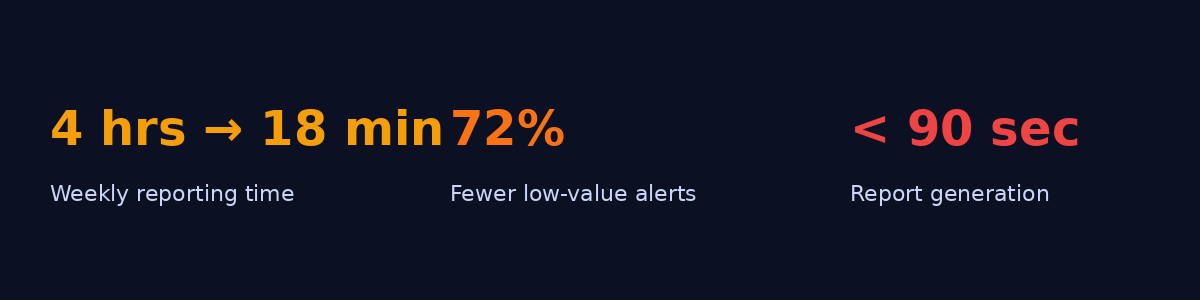
• Weekly reporting:
4 hours of manual work replaced by an auto-generated report in under 20 minutes end to end.
• Alert noise:
~72% fewer low-value alerts, because alerts fire on interpreted impact, not raw thresholds.
• Engineer focus:
on-call engineers report reclaiming roughly one full day per week previously lost to triage.
Ready to Stop Reading Alerts and Start Reading Answers?
DataFactZ deploys Claude CoWork-driven health reporting on top of your existing SQL Server and ADF estate typically in two to three weeks, using telemetry you already collect. No rip-and-replace, no new monitoring stack, no six-month consulting engagement. If your mornings start with alert triage instead of decisions, we’d like to show you what the first report would look like on your platform.
For more details - Get in touch